
.png)

WEEK ENDING 2/6/2026
- Volatility hits financial markets
- Job market slows, but don’t light your hair on fire
A CITY DIFFERENT TAKE
This week was filled with volatility.
When we began writing this piece on Friday morning, we had one set of conclusions. By the close of business on Friday, we had to rethink those conclusions. The following table shows some of the volatility experienced in several financial markets:
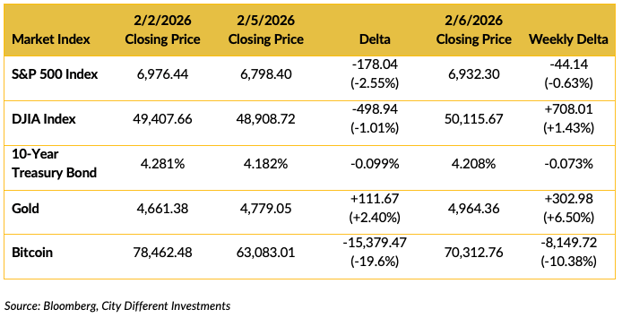
The equity markets shuddered on Thursday, and it was not from the cold East Coast weather. By Friday evening, most of those losses were recovered. In fact, the DJIA was up on the week and crossed 50,000 (for what it’s worth). The Wall Street Journal summarized the Thursday meltdown as follows:
“A simple set of industry-specific add-ons to its Claude product, including one that performed legal services, triggered a dayslong global stock selloff, from software to legal services, financial data and real estate. Then, Anthropic unveiled Super Bowl ads that taunt rival OpenAI.” WSJ
In addition, concern over the future AI infrastructure spend added to market pressure on Thursday, and by Friday, it turned into a positive for future GDP. Although it didn’t help Amazon’s stock price, which was down $32.64 (13.43% per share) since Monday’s close:
“Still, tech giants including Microsoft, Amazon.com, Meta Platforms, Oracle and Alphabet’s Google are planning more than $600 billion in 2026 capital spending, an amount that approaches the 2026 spending budget of Japan and exceeds that of Germany and Mexico. Anthropic — and all the ways the world might use its tools — are crucial drivers of that spending.” WSJ
The one conclusion that did not change, the above table seems to bring into question that Bitcoin, which has had a terrible few months, is “digital gold” or a “store of value.” Where did investors turn when faced with Thursday’s downdraft, at least in the short run? Good old bonds and gold.
Coupled with the above surprises were some private market economic releases that took center stage and got the cable talking heads spinning. Key government data like nonfarm payrolls and CPI have been delayed until next week due to the “short” government shutdown. The Bureau of Labor Statistics released its December JOLTS data, while the January releases were delayed by (you guessed it) the government shutdown. The following table highlights those releases and some summary CDI analysis:
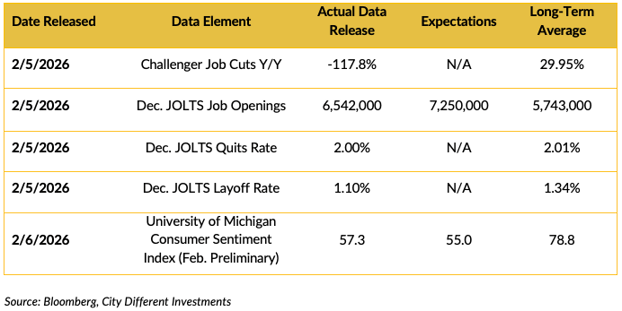 The Bureau of Labor Statistics published data showing that there are 1.1 job openings for every unemployed person as of December. (The long-term average is 1.81 since 1/1/2010)
What do we make of this data? Well, the job market is slowing but not “light your hair on fire” slowing. The Challenger Job cut is concerning until you realize that this data series is volatile; the time series has a standard deviation of 139.52%. The JOLTS jobs opening data is below expectations but above the long-term average, and our prism would say the reading is fair. The same goes for the Quits rate and the Layoff rate. We will start to get the delayed government data next week.
One final note: the consumer is grumpy. The affordability issue is real; U.S. Average hourly earnings (M/M) is barely keeping up with inflation as measured by the CPI index (the December M/M reading was 0.3% for both).
The fixed-income market has had a week to get used to the idea of Kevin Warsh as the new Chair of the Federal Reserve Board. Have the market implied probabilities of a Fed rate cut markedly changed? No. The next two Fed meetings have a probability of sub 20% and it is not until the June meeting that the probability increases to 57.8%.
CHANGES IN RATES
TreasuryMarket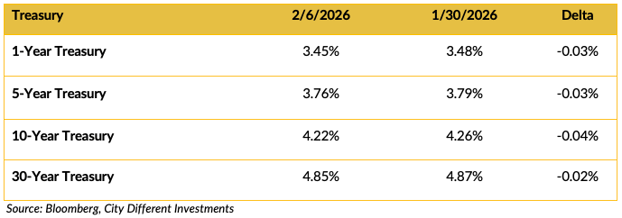
The Treasury rallied on Thursday as investors sought shelter from the storm that was Thursday’s equity markets. On Friday, as the equity markets recovered, the Treasury market gave back some of its gains. The 2/10 spread moved 2 basis points lower than last week: 0.72% vs 0.74%.
Municipal Market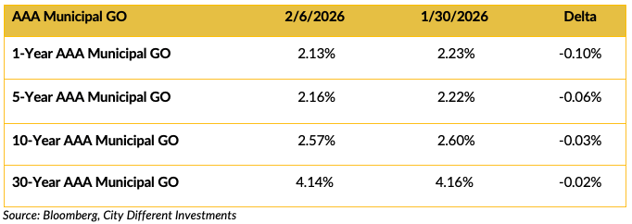
Municipal yields continued to drop, reflecting similar moves in the Treasury market. The only difference is that it gave nothing back on Friday. Next week, we anticipate $12+ billion in new issue municipal supply, which should be the first test of the new year. The 2/10 slope steepened from 0.40% to 0.46% for the week ending Feb. 6. (The long-term average is 1.49% since June 1994.)
Selected Municipal AAA General Obligation Bond / Selected Treasury Bonds Yield Ratio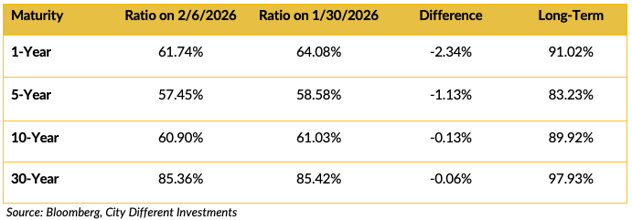
Treasury-muni ratios tightened be varying degrees across the yield curve.
Investment Grade Corporates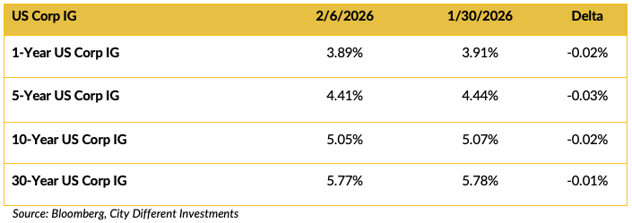
Investment-grade corporate bond yields reflected the Treasury curve moves.
THIS WEEK IN WASHINGTON

A four-day government shutdown ended this week. It did cause a delay in some government produced economic data. Some of those releases will be forthcoming this week. The one sticking point is the Department of Homeland Security reform tied to partial funding:
“Senate Minority Leader Chuck Schumer and House Minority Leader Hakeem Jeffries released a list of policies to impose ‘guardrails’ on DHS on Wednesday night, including by restricting immigration agents from wearing masks and requiring them to display an ID and use body cameras. The Democrats also demanded agents be banned from entering private property without judicial warrants, along with requiring agents to verify that someone is not a U.S. citizen before holding them in immigration detention, among other things.” CBS
Both parties seem to be far away from any compromise:
“Thune, a South Dakota Republican, called Democrats' demands ‘unrealistic and unserious,’ while saying they aren't ‘even willing to engage in a negotiation and discussion to try and reach a result.’” CBS
There was a new trade deal with India, which should put more pressure on Russia, and help Harley-Davidson:
“India will slash tariffs on high-end American cars to 30% from as high as 110% and eliminate duties on Harley-Davidson bikes under an interim trade pact, an official said, but will not make concessions for electric vehicles, a move that pointedly leaves Tesla (TSLA.O), opens new tab out.
“The U.S. and India moved closer to a trade pact after releasing an interim framework on Friday, days after President Donald Trump said duties on Indian exports would be cut to 18% from 50% in exchange for New Delhi halting purchases of Russian oil.” Reuters
As we mentioned earlier in this piece, the cable talking heads were lighting their hair on fire over some of the economic releases last week — both those that were delayed from December and some of the private sourced economic releases. Some at the Fed have a more balanced viewpoint.
“Federal Reserve Vice Chair Philip Jefferson said Tuesday the central bank should be careful how it adjusts interest rates amid an uncertain policy environment.
“In broad terms, the Fed governor said he sees the economy strong with inflation easing back on a ‘bumpy’ road to the central bank’s 2% goal and a labor market in a ‘solid position.’” CNBC
WHAT, ME WORRY ABOUT INFLATION?
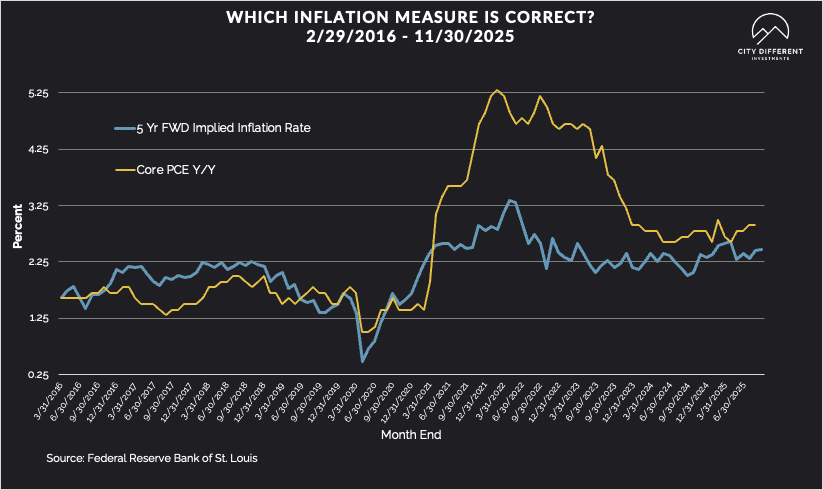
The 5-year Breakeven Inflation Rate finished the week of Feb. 6 at 2.50%, 3 basis points lower than last week. The 10-year Breakeven Inflation Rate finished the period at 2.34%, 2 basis points lower than last week.
MUNICIPAL CREDIT
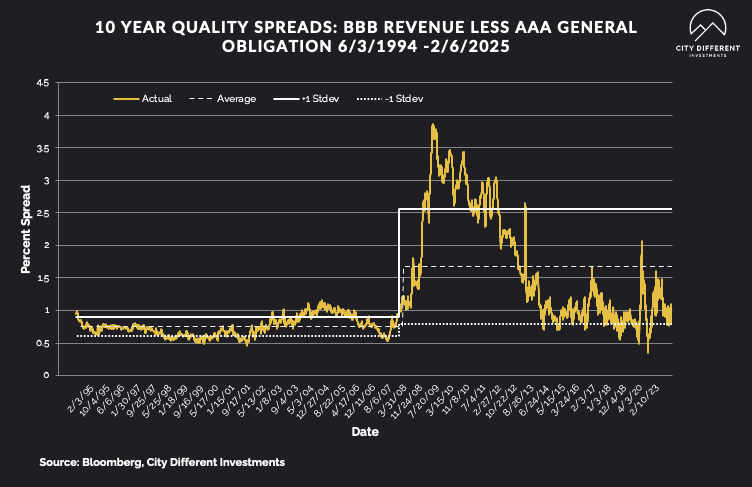
Last week's 10-year quality credit spread between BBB revenue bonds and AAA general obligation bonds remained unchanged at 0.91%. The historical average credit spread is at 1.68%.
TAXABLE CREDIT
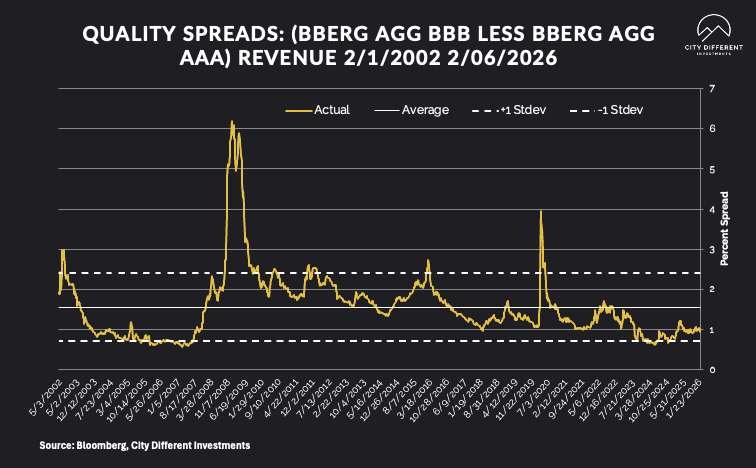
Investment-grade spreads are tight at 100 basis points this week. The long-term average is 1.56%.
WHERE ARE FIXED-INCOME INVESTORS PUTTING THEIR CASH?
Money Market Flows (millions of dollars)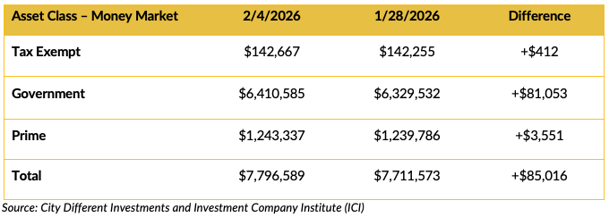
Money market fund flows were largely higher week-over-week.
Mutual Fund Flows (millions of dollars)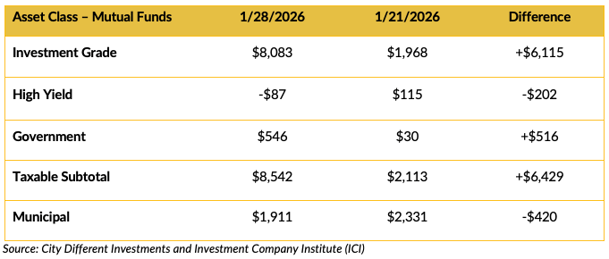
Mutual fund flows in total were mostly higher week over week.
ETF Fund Flows (millions of dollars)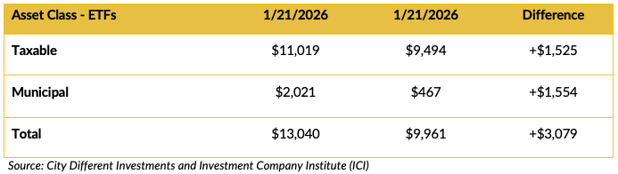
Net ETF flows were up week over week.
SUPPLY OF NEW ISSUE BONDS
Municipals are in a strong position as February begins. Higher new issue supply should test this strength. This week boasts a good calendar with supply at approximately $13 billion.
CONCLUSION
The economic data, along with at least one Fed governor, is mixed. The labor markets look to be weakening, but not “light your hair on fire” weakening. The inflation picture is still tough to measure. Core PCE is stubbornly above the Fed’s 2.00% target. Tariffs, based on Andy Jassy’s Davos comment, look to be hitting consumers. We referenced a Wall Street Journal article a couple of weeks ago that highlighted studies showing consumers end up paying these tariffs. The new Fed chair may bring a new slant to the Fed meeting debate — but he is only one out of twelve votes.
IMPORTANT DISCLOSURES
The information and statistics contained in this report have been obtained from sources we believe to be reliable but cannot be guaranteed. Any projections, market outlooks or estimates presented herein are forward-looking statements and are based upon certain assumptions. Other events that were not taken into account may occur and may significantly affect the returns or performance of these investments. Any projections, outlooks or assumptions should not be construed to be indicative of the actual events which will occur. These projections, market outlooks or estimates are subject to change without notice.
Please remember that past performance may not be indicative of future results. Different types of investments involve varying degrees of risk, and there can be no assurance that the future performance of any specific investment, investment strategy, or product or any non-investment related content, made reference to directly or indirectly herein will be profitable, equal any corresponding indicated historical performance level(s), be suitable for your portfolio or individual situation, or prove successful. Due to various factors, including changing market conditions and/or applicable laws, the content may no longer be reflective of current opinions or positions.
All indexes are unmanaged, and you cannot invest directly in an index. Index returns do not include fees or expenses. Actual portfolio returns may vary due to the timing of portfolio inception and/or investor-imposed restrictions or guidelines. Actual investor portfolio returns would be reduced by any applicable investment advisory fees and other expenses incurred in the management of an advisory account.
You should not assume that any discussion or information contained herein serves as the receipt of, or as a substitute for, personalized investment advice from City Different Investments. To the extent that a reader has any questions regarding the applicability above to his/her individual situation or any specific issue discussed, he/she is encouraged to consult with the professional advisor of his/her choosing. City Different Investments is neither a law firm nor a certified public accounting firm and no portion of this content should be construed as legal or accounting advice.
A copy of City Different Investments' current written disclosure statement discussing our advisory services and fees is available for review upon request.
Unless otherwise noted, City Different Investments is the source of information presented herein.
A description of the indices mentioned herein is available upon request.