
.png)

WEEK ENDING 1/16/2026
- Inflation cools, though incomplete data fuels policy uncertainty
- Fed independence is a high-stakes game
- Fiscal tailwinds and economic resilience
A CITY DIFFERENT TAKE
Underlying inflation momentum is firmly cooling as the economy moves into 2026, with the “supercore” CPI (services excluding shelter) dropping to its lowest level since 2021. While the late-2025 government shutdown created significant data “noise” and technical distortions in shelter reporting that will take months to clear, the peak of the tariff pass-through shock appears to have passed in October. Fixed-income markets are now pricing in a return to steady disinflation, as core goods prices remained virtually unchanged in December. However, given the technical gaps in recent reports, the FOMC is expected to view this cooling with caution, requiring more “clean” data before committing to significant policy easing in the first half of the year. Sure enough, the PPI data for November rose by 0.2% on the heels of a cooler than anticipated CPI, adding to data confusion post government shutdown.
The institutional independence of the Federal Reserve is currently facing an unprecedented test as the executive branch increases pressure on the Board. The week was marked by Chair Jerome Powell’s defiance following a DOJ subpoena — which he characterized as a pretext for political pressure on interest rates — and his high-profile attendance at the Supreme Court’s Cook v. Trump arguments regarding the president's authority to fire Fed governors. This friction has shifted market expectations for the next Fed Chair; while NEC Director Kevin Hassett was long considered the frontrunner, his perceived lack of distance from the White House has led markets to pivot toward Kevin Warsh. With a more hawkish FOMC voter rotation this year, the Fed appears structurally positioned to resist unwarranted political pressure for rate cuts, reinforcing a “higher-for-longer” narrative.
Despite the trade and policy volatility of the past year, the U.S. economy enters 2026 with “shockingly strong” momentum, supported by a collapsing trade deficit and resilient consumer spending. Growth is expected to be further goaded by the One Big Beautiful Bill Act (OBBBA), which is projected to inject nearly $200 billion into disposable personal income this year through enhanced tax refunds and updated withholding guidance. This fiscal impulse, combined with “green shoots” in the housing market as mortgage rates stabilize, has pushed GDP forecasts for the coming year toward a “frothy” 3% to 5% range. For fixed-income investors, this robust growth profile complicates the path for rate cuts, as the combination of tax breaks and business investments may keep the economy running hot enough to prevent the Fed from easing policy as aggressively as the market initially anticipated.
TreasuryMarket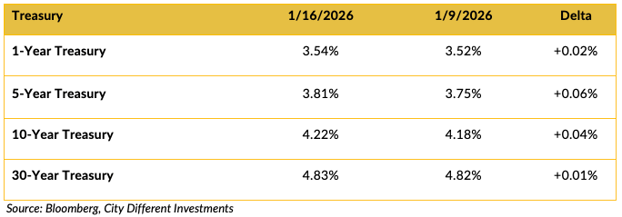
The Treasury yields rallied last week especially in the belly of the curve. The 2/10 spread remained the same as last week at 64 basis points for the period. This is because yields rallied across the curve.
Municipal Market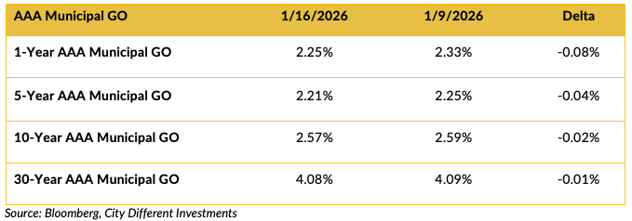
The “January Effect” continues into the third week of the month. Prices kept rallying in the muni market. The 2/10 slope steepened at 35 basis points, 4 basis points higher than the week before. (The long-term average is 1.49%.)
Selected Municipal AAA General Obligation Bond / Selected Treasury Bonds Yield Ratio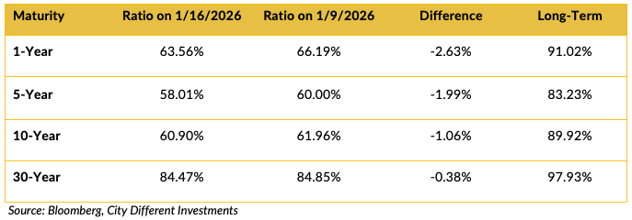
Treasury-muni ratios lowered across the board due to the muni curve as the “January Effect” deepens.
Investment Grade Corporates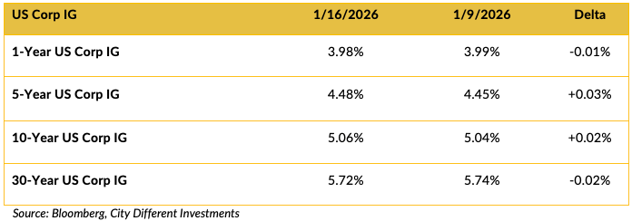
Investment-grade corporate bond yields rallied between the 10-to-15-year part of the curve.
THIS WEEK IN WASHINGTON
Negotiations for Department of Homeland Security (DHS) funding have stalled following the fatal shooting of Renee Good during an ICE operation in Minneapolis. Democrats are demanding new restrictions on the agency, while Republicans are resisting. However, the government did move swiftly to avoid a partial shutdown looming on January 30. Congress moved on several “minibus” spending packages to fund the government through the end of FY2026. The House passed a three-bill package covering Energy-Water, Interior-Environment, and Commerce-Justice-Science.
In foreign policy news, the Senate held a rare and tense vote regarding military action in Venezuela. In a 50-50 tie broken by Vice President JD Vance, the Senate blocked a bipartisan resolution that would have required the president to seek congressional authorization before further military force in Venezuela. This follows a recent U.S. raid to apprehend Nicolás Maduro. Two Republicans flipped their votes after receiving private assurances from Secretary of State Marco Rubio that major troop deployments were not currently planned.
The administration is using threats of a 10% tariff as leverage to pressure Denmark into selling Greenland to the United States. The rate is scheduled to jump to 25% on June 1 unless a deal is reached. The fear here is that European countries hold $10 trillion of U.S. assets in the form of bonds and stock according to Bloomberg. They hold about 40% of foreign U.S. treasuries. “Weaponization of capital” is a term that has been floated around in this context. However, these assets mostly reside in private funds that are not in the European government’s purview. Also, any escalation here would result in a trade war spilling into the financial markets.
In relation to the unrest in Iran, the administration has signaled that it is holding off on an attack for now. The U.S. had redeployed some personnel in Qatar and other American bases in the region in anticipation of Iranian threats. Iran’s supreme Leader Ayatollah Alo Khamenei has acknowledged that several thousand people have died this month in anti-government demonstrations.
WHAT, ME WORRY ABOUT INFLATION?
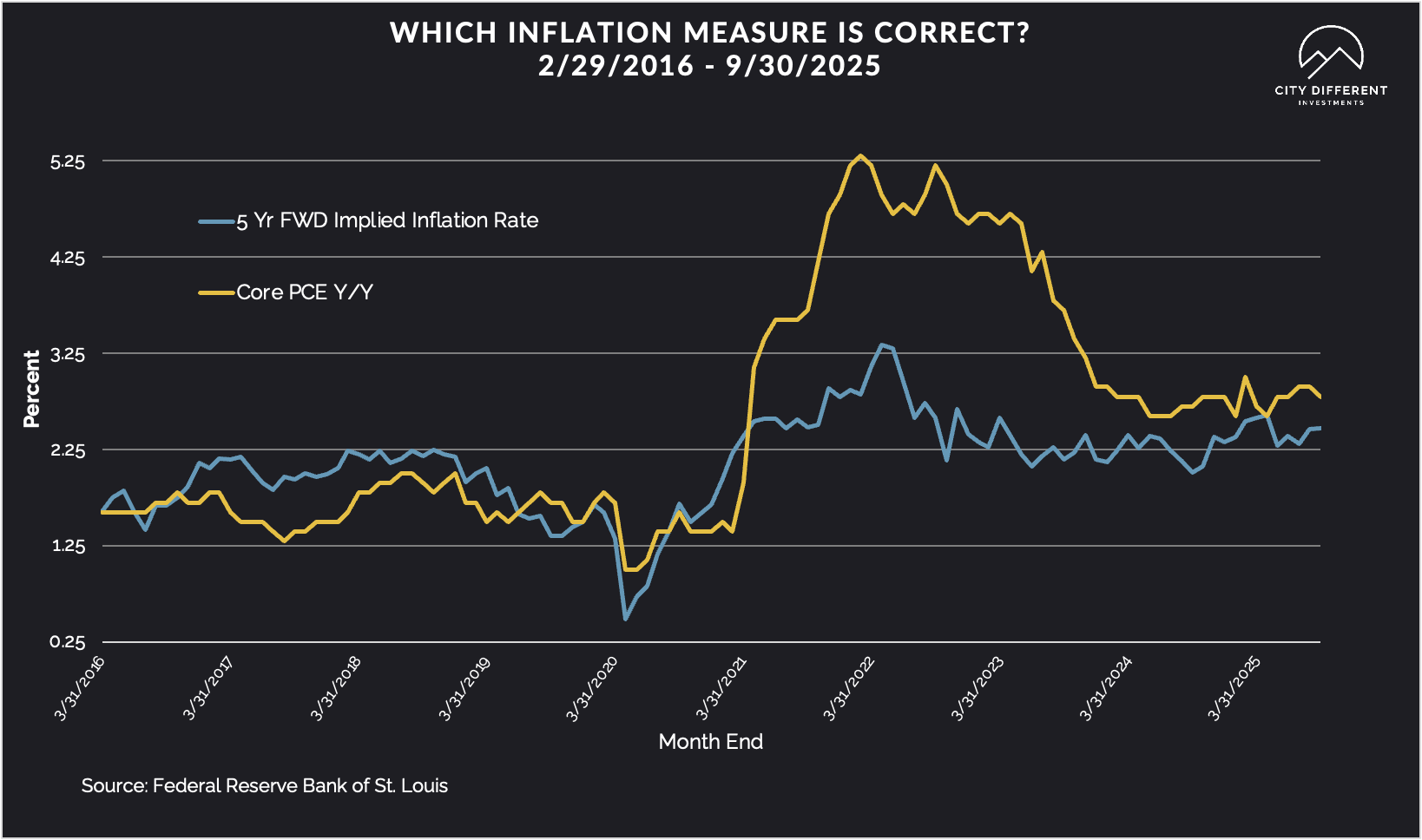
The 5-year Breakeven Inflation Rate finished the week of Jan. 16, 2026, at 2.27%, 5 basis points lower than last week. The 10-year Breakeven Inflation Rate finished the period at 2.33%, 5 basis points higher than last week.
MUNICIPAL CREDIT
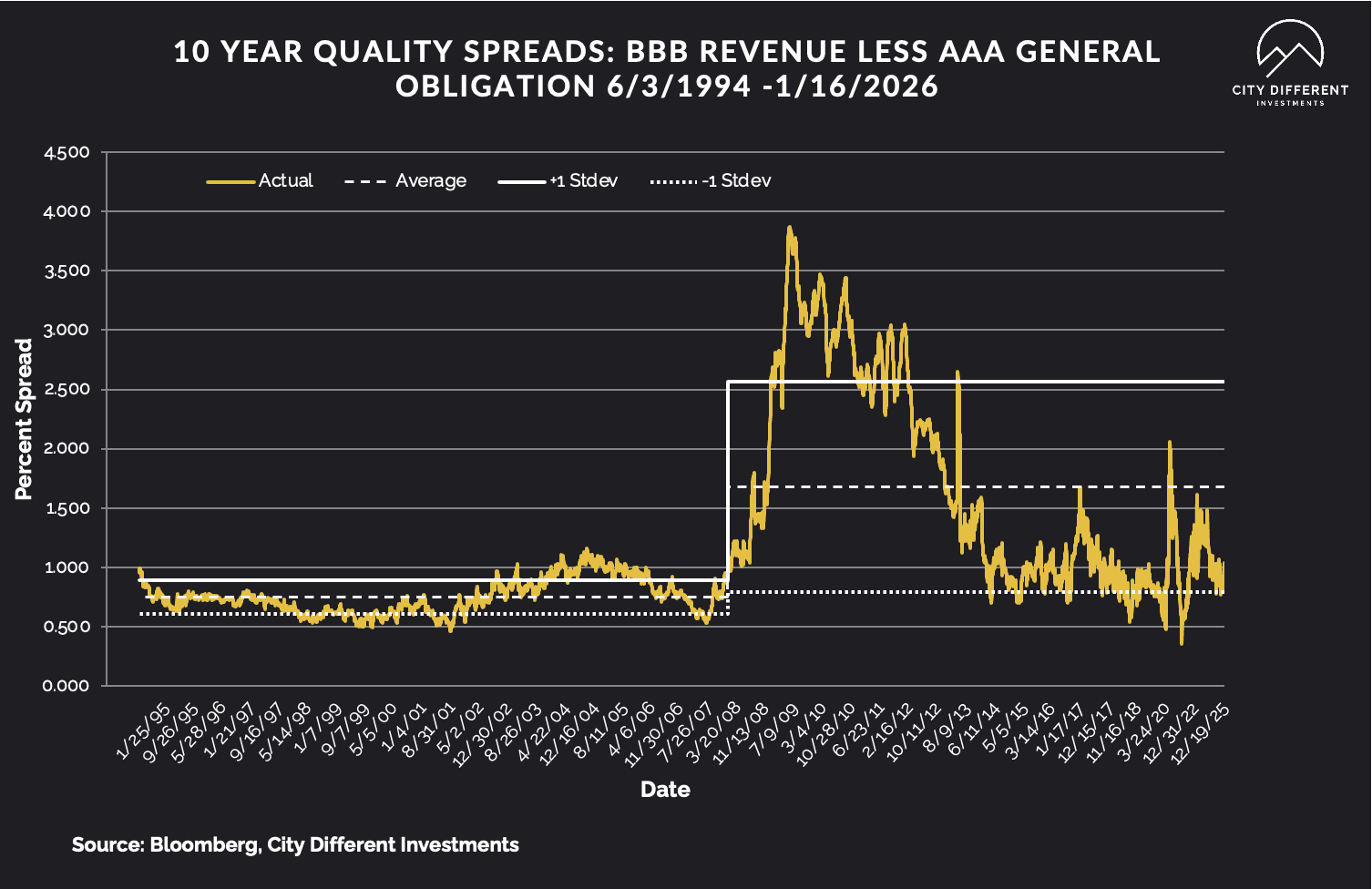
Last week's 10-year quality credit spread stayed stagnant week over week between BBB revenue bonds and AAA general obligation bonds at 0.96%. The historical average credit spread is at 1.68%.
TAXABLE CREDIT
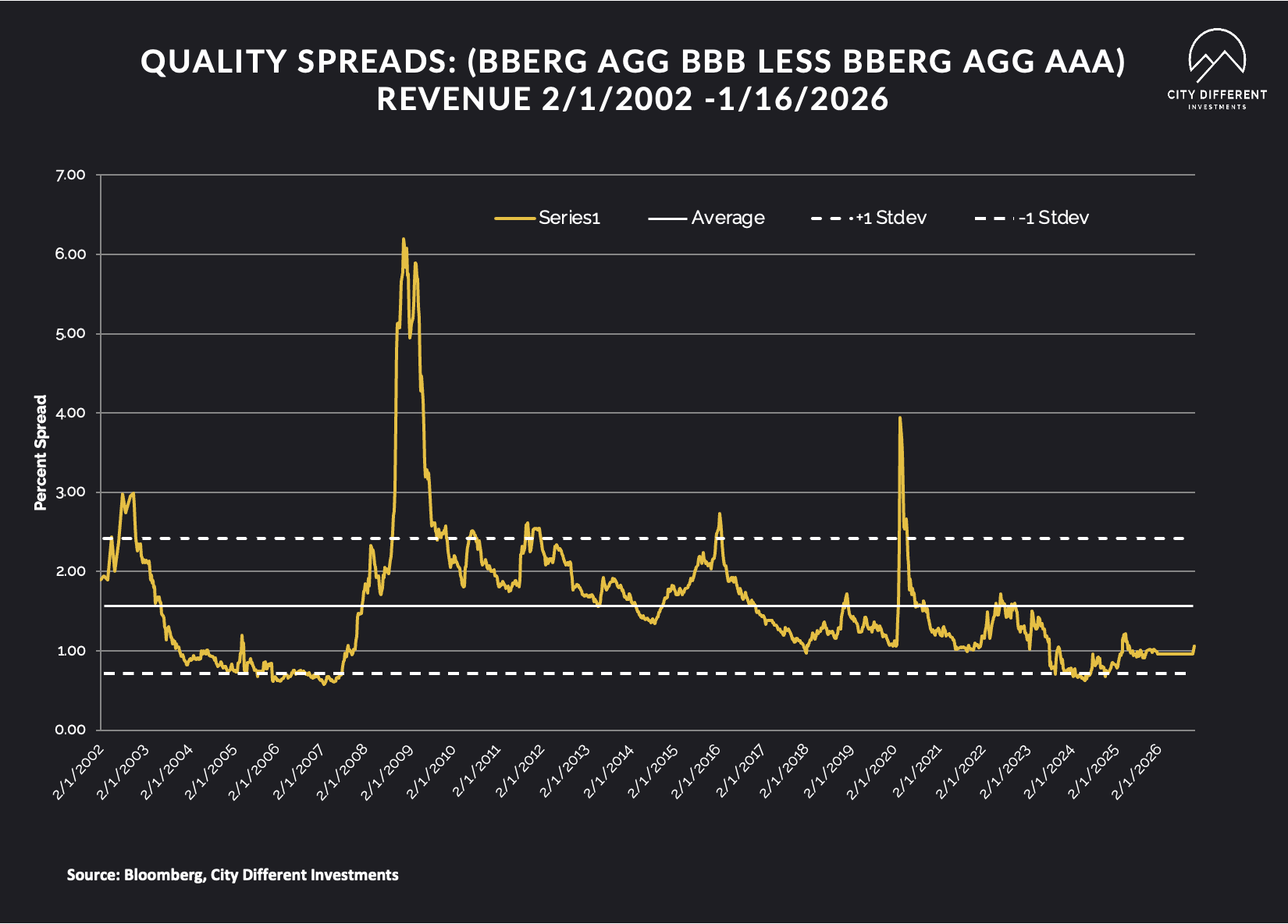
Investment-grade spreads are at all-time tights at 75 basis points this week. The long-term average is 1.57%.
WHERE ARE FIXED-INCOME INVESTORS PUTTING THEIR CASH?
Money Market Flows (millions of dollars)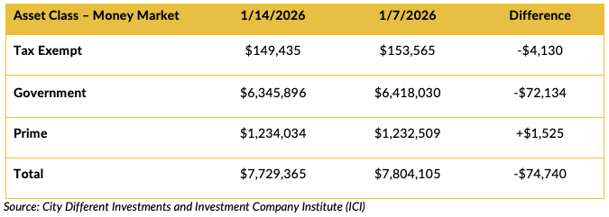
Money market fund flows were negative except for prime funds.
Mutual Fund Flows (millions of dollars)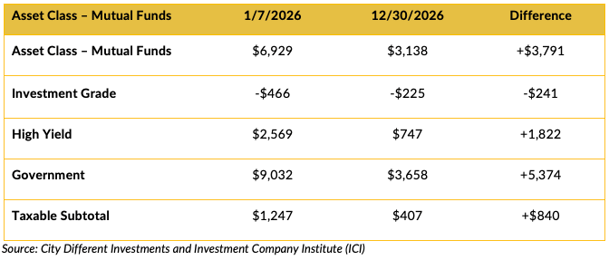
Mutual fund flows in total were up week over week.
ETF Fund Flows (millions of dollars)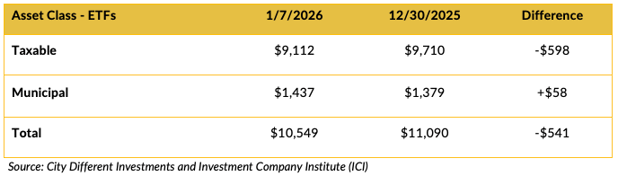
Net ETF flows were negative except for municipals.
SUPPLY OF NEW ISSUE BONDS
This week’s supply is strong at $12 billion in tax-exempt markets. The fund flows show the increased appetite in munis. The rich valuations further make this point.
CONCLUSION
The outlook for 2026 is defined by a paradox of cooling inflation and accelerating growth, further complicated by an institutional tug-of-war over the Federal Reserve. While the “supercore” data suggests that the worst of the inflationary shock is over, the combination of significant fiscal stimulus from the OBBBA and “noisy” post-shutdown data makes a near-term rate cut unlikely.
IMPORTANT DISCLOSURES
The information and statistics contained in this report have been obtained from sources we believe to be reliable but cannot be guaranteed. Any projections, market outlooks or estimates presented herein are forward-looking statements and are based upon certain assumptions. Other events that were not taken into account may occur and may significantly affect the returns or performance of these investments. Any projections, outlooks or assumptions should not be construed to be indicative of the actual events which will occur. These projections, market outlooks or estimates are subject to change without notice.
Please remember that past performance may not be indicative of future results. Different types of investments involve varying degrees of risk, and there can be no assurance that the future performance of any specific investment, investment strategy, or product or any non-investment related content, made reference to directly or indirectly herein will be profitable, equal any corresponding indicated historical performance level(s), be suitable for your portfolio or individual situation, or prove successful. Due to various factors, including changing market conditions and/or applicable laws, the content may no longer be reflective of current opinions or positions.
All indexes are unmanaged, and you cannot invest directly in an index. Index returns do not include fees or expenses. Actual portfolio returns may vary due to the timing of portfolio inception and/or investor-imposed restrictions or guidelines. Actual investor portfolio returns would be reduced by any applicable investment advisory fees and other expenses incurred in the management of an advisory account.
You should not assume that any discussion or information contained herein serves as the receipt of, or as a substitute for, personalized investment advice from City Different Investments. To the extent that a reader has any questions regarding the applicability above to his/her individual situation or any specific issue discussed, he/she is encouraged to consult with the professional advisor of his/her choosing. City Different Investments is neither a law firm nor a certified public accounting firm and no portion of this content should be construed as legal or accounting advice.
A copy of City Different Investments' current written disclosure statement discussing our advisory services and fees is available for review upon request.
Unless otherwise noted, City Different Investments is the source of information presented herein.
A description of the indices mentioned herein is available upon request.