
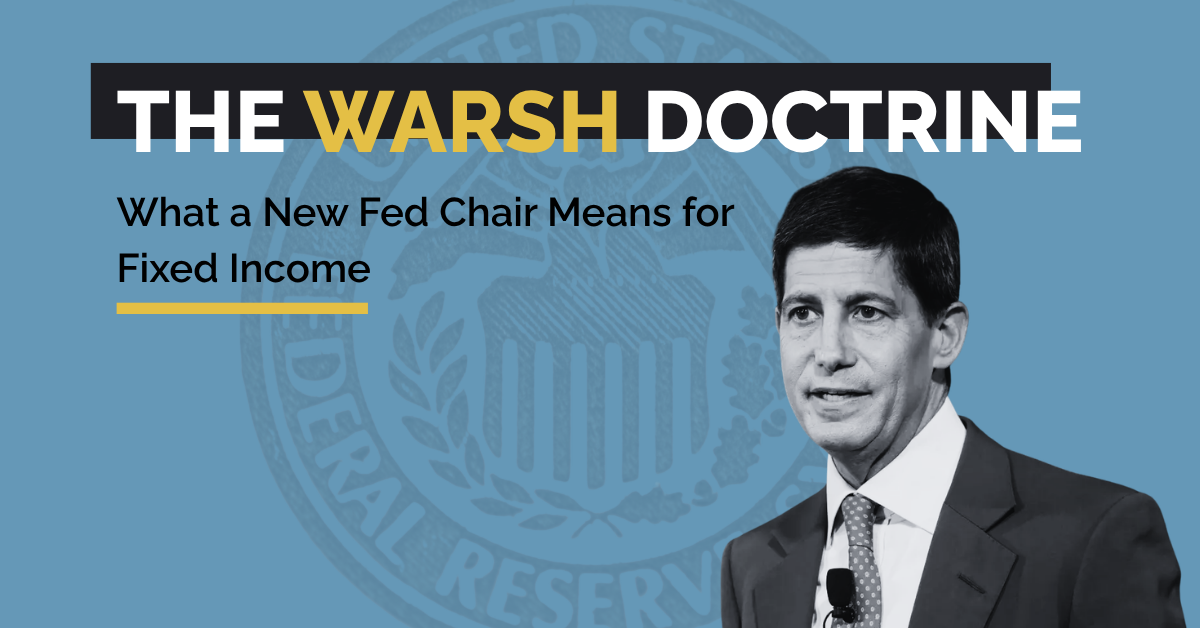
What a New Fed Chair Means for Fixed Income
Kevin Warsh took the helm on May 15, 2026, and has pledged to change the conduct of monetary policy. For fixed-income investors, this is not a transition to monitor from afar. It is a shift that will directly affect duration positioning, curve exposure, and portfolio convexity.
.png?width=793&height=248&name=cell%20tower%20header%20(15).png)
Five Pillars of the Warsh Doctrine
1. A New Inflation Framework
Warsh has publicly rejected core PCE, the Fed's benchmark measure for two decades, calling it a rough approximation. He favors trimmed mean PCE from the Dallas Fed and median PCE from the Cleveland Fed. At the March reading, core PCE sits at 3.2%, more than a full percentage point above the Fed's 2% mandate. The Dallas trimmed mean reads 2.4%. If Warsh governs by that framework, the effective starting point for rate-cutting policy moves 80 basis points closer to the target without a single price changing.
CDI Perspective: The credibility risk is real. Operation Epic Fury has introduced a multi-year supply-side energy shock. The Dallas Fed has warned that trimmed-mean measures can understate the broadening inflationary pressures at the beginning of a new inflation cycle. If the trimmed mean accelerates under Warsh, he cannot walk back his preferred framework without appearing to select whatever measure is most convenient. That erosion of credibility is a risk the bond market will price.
2. Quantitative Tightening and the Balance Sheet
Warsh views the Fed's $6 trillion balance sheet as structurally inconsistent with its mandate. He is expected to pursue an accelerated pace of Quantitative Tightening, reducing the Fed's holdings of Treasuries and mortgage-backed securities. A sustained seller of this scale will put upward pressure on yields, particularly at the long end of the curve.
CDI Perspective: Active balance sheet reduction steepens the yield curve and reintroduces term premium. Investors who have been compensated roughly equally for holding two-year and ten-year paper will see that relationship reprice. Understanding your portfolio's curve distribution and convexity exposure is no longer optional.
3. The QT-for-Cuts Framework
Warsh is expected to pursue rate cuts through two channels: an AI-driven productivity argument that justifies lower policy rates even amid solid growth, and a financial conditions-neutral framework in which lower short-term shrinkage costs are offset by sheet balance, thereby lowering shrinkage. In practice, this means QT and rate cuts could proceed simultaneously, a novel experiment the market has not yet digested.
CDI Perspective: Warsh inherits an FOMC already divided. Three regional presidents, Hammack, Kashkari, and Logan, publicly dissented from the easing bias in Powell's final statement. Warsh would be historically cautious about becoming the first Fed chair to lose a policy vote. The QT-for-cuts framework may be his vision, but the committee sets the pace.
4. End of Forward Guidance and the Dot Plot
Warsh has signaled he wants to eliminate forward guidance, the practice of telegraphing future rate decisions, and has declined to commit to holding a press conference after every meeting. The dot plot, which has anchored market rate expectations for over a decade, could effectively be retired under his leadership.
CDI Perspective: The removal of forward guidance increases the dispersion of rate path outcomes. Markets that the dot plot has anchored will need to recalibrate. Wider uncertainty around policy direction is systematically favorable to active management and systematically unfavorable to strategies that rely on stable, predictable rate expectations.
5. The Fed/Treasury Accord and Institutional Independence
Warsh has framed Fed independence as strictly limited to monetary policy decisions, and has signaled willingness to coordinate with Treasury on non-monetary matters, including balance sheet governance. The contours of a new Fed/Treasury accord remain undefined, but the concept raises a structural question about how independently the Fed will manage its balance sheet.
CDI Perspective: A more openly divided FOMC, combined with a new and untested accord with Treasury, means less predictability. Convexity matters. A negatively convex portfolio extends duration when rates rise and shortens duration when rates fall. That asymmetry is always unfavorable and becomes critically so when the policy path is genuinely uncertain.
The Warsh transition is not a binary event for bond investors. It is a structural shift across five dimensions simultaneously: inflation measurement, balance sheet policy, rate philosophy, communication, and institutional independence. Any one of these would warrant a portfolio review. All five arriving together warrant a disciplined reassessment of duration, curve positioning, and convexity.
IMPORTANT DISCLOSURES
The information contained in this communication has been designed for general informational, illustrative, and educational purposes only and does not constitute an offer to sell or a solicitation of an offer to buy any security. Moreover, the information provided is not intended to provide any investment advice whatsoever. Different types of investments involve varying degrees of risk, and there can be no assurance that the future performance of any specific investment, investment strategy, or product, or any non-investment related content, made reference to directly or indirectly in this communication will be profitable, equal any corresponding indicated historical performance level(s), be suitable for your portfolio or individual situation or prove successful. Due to various factors, including changing market conditions and/or applicable laws, the content may no longer be reflective of current opinions or positions. No discussion or information contained herein serves as the provision of, or as a substitute for, personalized investment advice. To the extent that a reader has any questions regarding the applicability above to his/her individual situation of any specific issue discussed, he/she is encouraged to consult with the professional advisor of his/her choosing. City Different Investments is neither a law firm nor a certified public accounting firm and no portion of this content should be construed as legal, tax, or accounting advice.
The presented information and statistics have been obtained from sources we believe to be reliable but cannot be guaranteed. Any projections, market outlooks or forecasts discussed herein are forward-looking statements and are based upon certain assumptions. Other events that were not taken into account may occur and may significantly affect the returns or performance of these investments. Any projections, outlooks or assumptions should not be construed to be indicative of the actual events which will occur. These projections, market outlooks or estimates are subject to change without notice. Please keep in mind that past performance may not be indicative of future results.