
.png)

WEEK ENDING 2/20/2026
- SCOTUS strikes down tariffs 6-3
- Big, confusing data for a holiday-shortened week
- Q4 GDP not so bad after adjusting for the government shutdown
A CITY DIFFERENT TAKE
There has been a lot of data released in this holiday shortened week. The table below summarizes a sample:
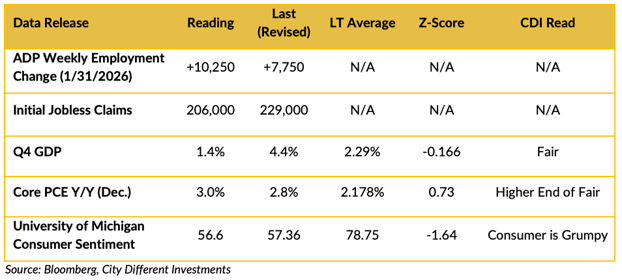
CDI’s read on these data releases are:
1) The employment picture looks low but stable. The no-hire/no-fire environment is intact.
2) Inflation looks problematic and well above the Fed’s 2.00% target. Based on real yields the Treasury market looks fair. The 10-year Treasury real yield — based on a 4.09% yield and 3.00 Y/Y core PCE — gives you a real yield of +1.09%. The long-term average of this measure is +1.42, with a z-score of -0.07. A long-winded way of saying the 10-year real yield is fair. In the municipal market, a 10-year AAA general obligation bond yields 2.49 versus Y/Y Core PCE of 3.00% yields real yield of -0.51%. The long-term average of this measure is -0.29% with a z-score of -0.37. This is a fair measure by our calculations
The Q4 GDP reading of 1.4% was initially concerning until factoring in the longest government shutdown in history.
“The BEA estimated that the reduction in government services subtracted about 1 percentage point from real GDP growth in the fourth quarter.” Barron's
Some reduction estimates are as high as 1.5%. But if we make that 1% adjustment to the Q4 GDP release, then the result would be a reading of 2.4% — right on top of the 2.3% (the long-term average, as CDI calculates it).
Finally, the consumer is still “grumpy.” The University of Michigan Consumer Sentiment release of 56.6 is well below the long-term average (as CDI calculates it) of 78.75 for a z-score of -1.64. That’s troubling! This reading is an increase from December’s 56.4, but we think it is a stretch to classify this move as the Wall Street Journal headline does:
“Consumers’ Mood Brightened in February, Michigan Survey Finds” WSJ
Both readings are well below the long-term average of 78.75.
CHANGES IN RATES
TreasuryMarket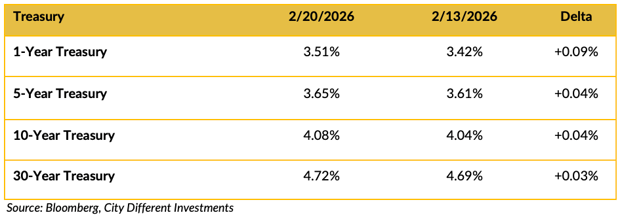
announcements. The 2-year yield increased 8 basis points. The 10-year yield increased by 4 basis points. The 2/10 spread lowered from last week by 4 basis points (0.60% vs. 0.64%).
Municipal Market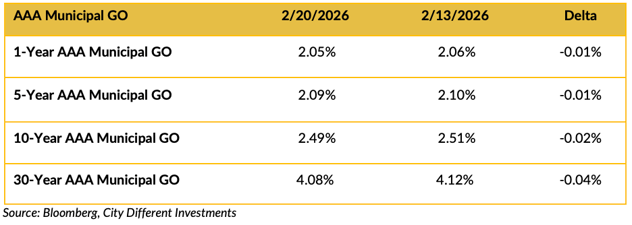
The municipal market’s January relative rally continued but was muted. The 2/10 spread for last week is at 45 basis points, bouncing around since the beginning of the year.
Selected Municipal AAA General Obligation Bond / Selected Treasury Bonds Yield Ratio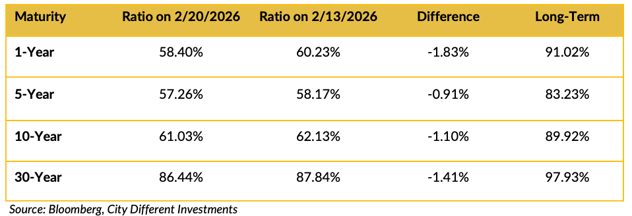
Treasury-muni ratios tightened across the yield curve.
Investment Grade Corporates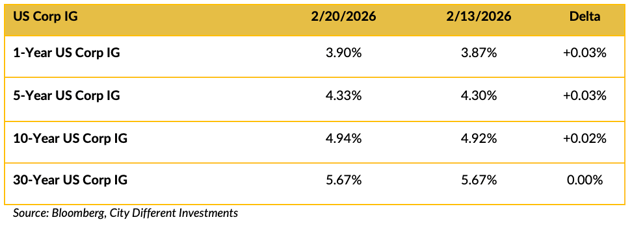
Investment-grade corporate bond yields were marginally higher week over week.
THIS WEEK IN WASHINGTON

We could start by talking about the arrest of former Prince Andrew. Or all the corporate executives that have been removed from their positions due to their names appearing in the Epstein files. Or how current administration officials named in the Epstein files have remained in their positions. Or the new DHS airplane that will be used for “deportations” in what can only be described as very luxurious appointments.
But we think the big news came from SCOTUS on Friday and the 6-3 decision striking down Trump’s tariffs, written by Chief Justice John Roberts. (Do you think Kevin Hasset will be calling for the chief justice to be disciplined?) From the Wall Street Journal:
Supreme Court Strikes Down Trump’s Global Tariffs:
The President exceeded his powers by imposing duties without clear authorization from Congress WSJ and Tariffs
“The 6-3 decision, written by Chief Justice John Roberts, removes a diplomatic tool that Trump has aggressively wielded to remake U.S. trade deals and collect tens of billions of dollars from companies importing foreign goods. The ruling didn’t address whether the government will have to pay back the tariff revenue it already has collected.
“The ruling will likely prompt the White House to try to re-enact the tariffs using other legal justifications. The administration does have other laws it can rely on, but those laws have procedural constraints and might not allow tariffs as expansive as the ones the court struck down.
“It wasn’t immediately clear whether the administration will have to issue refunds to companies that have been paying tariffs for months. The Supreme Court majority didn’t address that question, and it will likely be hashed out in the lower courts.” WSJ and Tariffs
The Supreme Court’s ruling did not address tariff refunds. The refund question is interesting as is the impact of the tariff removal on the U.S. deficit.
“The removal of tariff revenue could worsen the nation's budget shortfall by about $2 trillion over the next decade, according to the Committee for a Responsible Federal Budget.
“Tariff revenue in all of fiscal year 2025 was $195 billion; the government has collected $28 billion in tariffs since the fiscal year began in October. This revenue had been helping offset the federal deficit. The Supreme Court has now ruled that President Donald Trump's tariffs were invalid.” Barron's on Tariffs
Illinois Governor JB Pritzker has already gotten in line:
“Illinois Gov. JB Pritzker sent a letter to the president on Friday demanding a refund of $1,700 ‘for every family in Illinois.’ According to his letter, Pritzker said this would bring the total owed to more than $8 billion” Please, Sir, May I Have a Refund?
Treasury Sectary Scott Bessent thinks the chances of a refund to American consumers are between slim and none:
“Bessent said litigation over refunds could turn into a months- or years-long process, and ‘could be a mess.’ Earlier Friday, when asked about potential refunds at an Economic Club of Dallas event, the Treasury chief said he had ‘a feeling the American people won’t see it.’” Unlikely Refunds.
If the government must refund the already collected tariffs to the companies who paid them, do those same companies have to refund them to the consumers who ultimately paid them? Or is it a windfall for the companies and a kick in the shin for the consumer? You be the judge!
Here is another issue: if a company has increased prices due to the tariffs, will it reduce prices to fully reflect this windfall? Again, you be the judge — but we think not. The larger deficit expectation may put pressure on long-term Treasury yields as investors factor in increased Treasury borrowing.
In response to the Court’s tariff ruling, the president announced more tariffs:
“President Trump will impose a 10% global tariff under a different authority to replace those thrown out by the Supreme Court on Friday, and said he was ‘ashamed of certain members of the court’ over the ruling.” WSJ Again
On Saturday, President Trump increased the “global tariff” rate to 15%. The global tariff rate is only good (?) for 150 days without congressional approval. This should only lead to more market volatility — and maybe a change in some of the old economic correlations.
WHAT, ME WORRY ABOUT INFLATION?
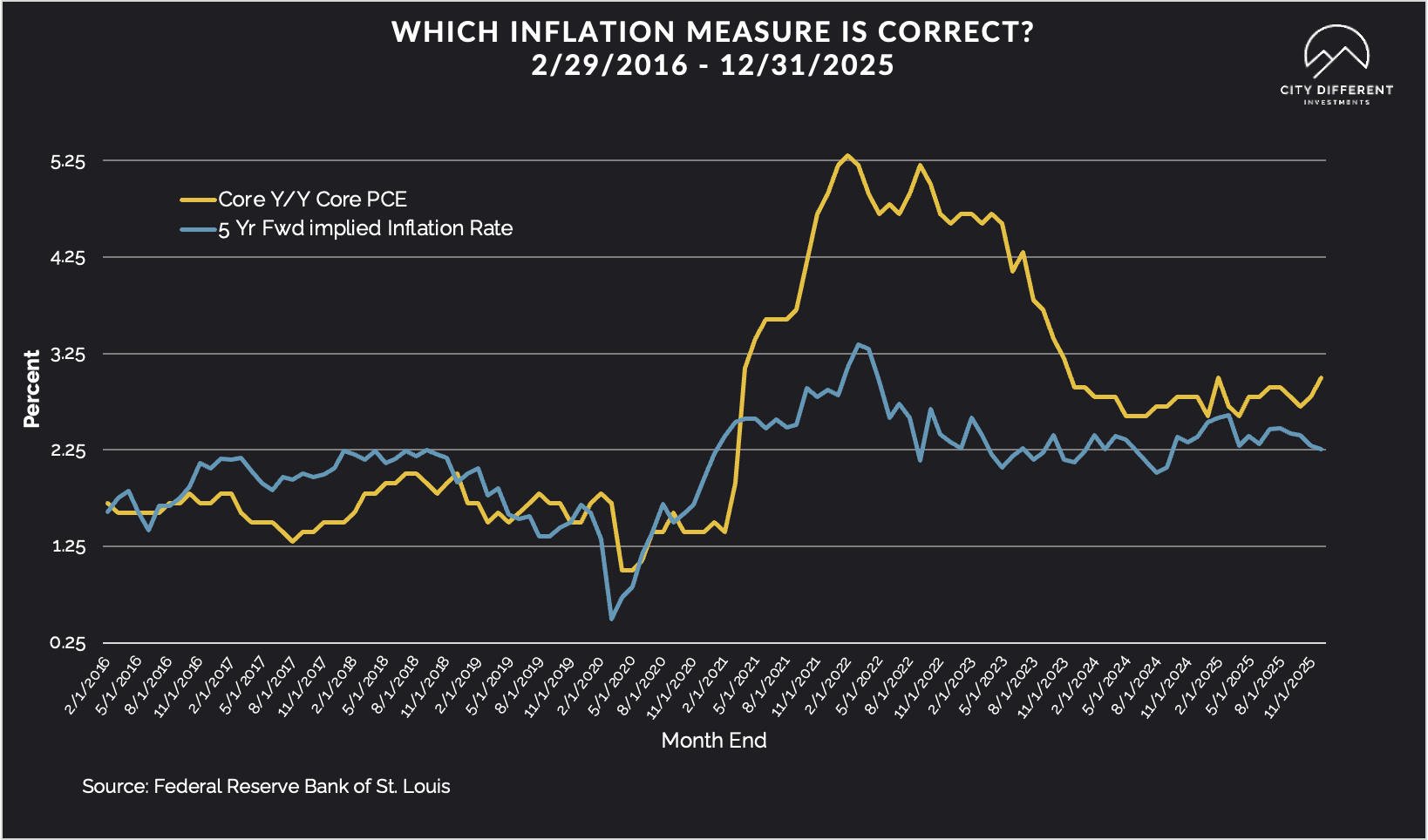
The 5-year Breakeven Inflation Rate finished the week of Feb. 20 at 2.43%, 1 basis point higher than last week. The 10-year Breakeven Inflation Rate finished the period at 2.28%, 1 basis point lower than last week.
MUNICIPAL CREDIT
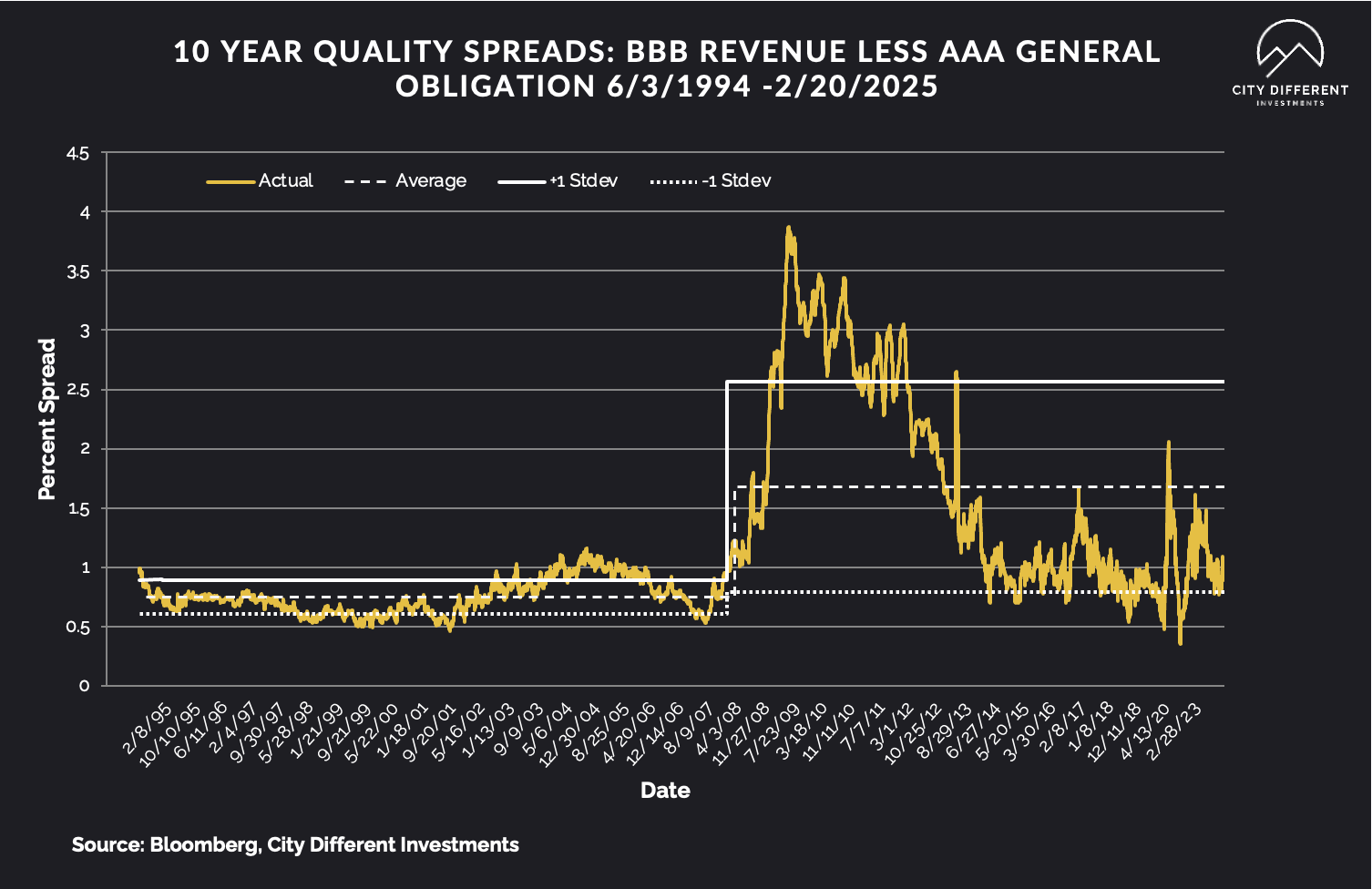
Last week's 10-year quality credit spread between BBB revenue bonds and AAA general obligation bonds was unchanged for the week at 0.89%. The historical average credit spread is at 1.68%.
TAXABLE CREDIT
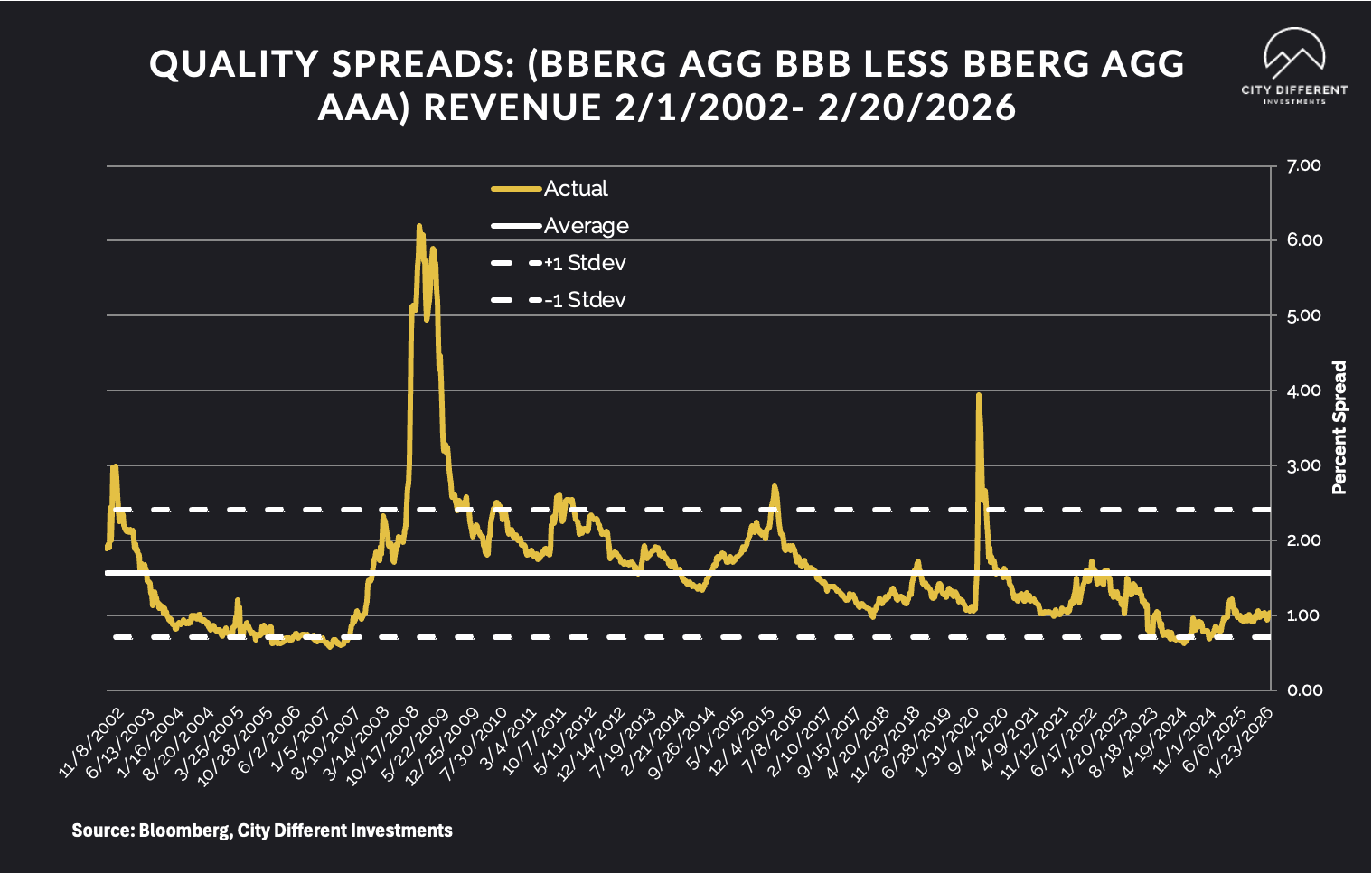
Investment-grade spreads are 100 basis points this week. The long-term average is 1.56%. One of the reasons for the prolonged tightness of corporate credit spreads could be the expansion of “private credit.” This opaquer segment of the credit markets has gained market share at the expense of the public markets. Some have felt that the private credit markets are getting crowded as new participants accept riskier deals to meet investor demand.
Are the private markets signaling credit trouble on the horizon? Are we approaching a “Minsky moment”? What is a “Minsky moment”? Well, Investopedia defines it as:
“A Minsky moment refers to a sudden collapse of asset prices after a long period of growth sparked by debt or currency pressures. It's at the explosive juncture of an economy about to fall.”
A Black and Blue Owl Moment:
“The private credit boom is facing a new test after Blue Owl Capital permanently restricted withdrawals from one of its retail-focused debt funds.
Shares in Blue Owl Capital fell nearly 6% on Thursday after the private market and alternative assets manager sold $1.4 billion of loan assets held in three of its private debt funds.
“The biggest portion of the sale came from a semi-liquid private credit fund marketed to U.S. retail investors called the Blue Owl Capital Corporation II, which will stop offering quarterly redemption options to investors, reigniting debate over whether stress was beginning to resurface in one of Wall Street’s fastest-growing corners.” Black and Blue Owl?
Nothing is better than telling your investors they cannot get their money back!
“‘The fundamental problem private market deals have is multi-year commitments that don’t line up with quarterly redemptions,’ said Michael Shum, CEO of Cascade Debt, which builds infrastructure software for private credit and asset-based lenders.
“‘When times are good, cashflows cover normal redemption requests. When times are bad, requests surge and it becomes a race to the bottom,’ he said.” Canary in a coal mine?
Some may say that we are “nervous Nellies” — but as bond folk we are paid to be nervous.
WHERE ARE FIXED-INCOME INVESTORS PUTTING THEIR CASH?
Money Market Flows (millions of dollars)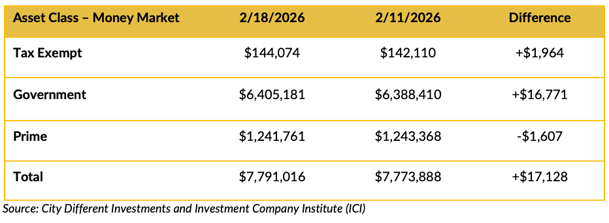
Money market fund flows were largely higher week-over-week.
Mutual Fund Flows (millions of dollars)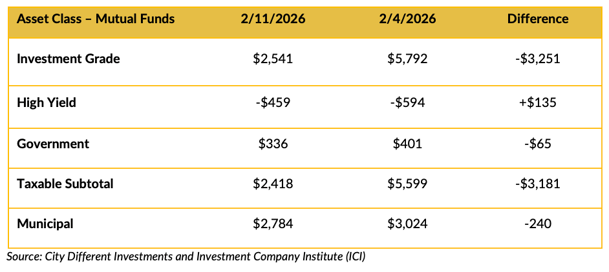
Mutual fund flows were mixed for last week.
ETF Fund Flows (millions of dollars)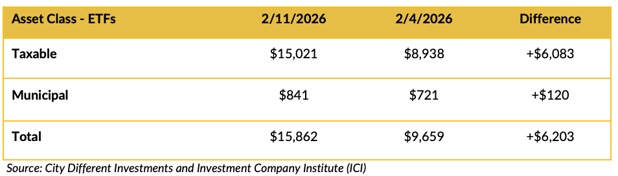
Net ETF flows were weak, down in all categories.
SUPPLY OF NEW ISSUE BONDS
Next week’s calendar of new municipal bond deals coming to market is expected to be approximately $9.6 billion. JP Morgan’s longer-term view is:
“At $60 billion, net supply over the next four months is expected to exert some pressure on the tax-exempt market.”
The January effect may be reaching its climax.
CONCLUSION
The labor markets appear steady, but at lower rates. Unemployment is at 4.3%, well below the long-term average for this time series (going back to March of 2004) of 5.74% as calculated by CDI. Q4 GDP was low at 1.4%. But after accounting for the government shutdown, it was right in line with the long-term average (going back to December 2003) of 2.29% as calculated by CDI. As of Feb. 20, Q1 GDP as estimated by the Atlanta Fed is 3.1%, also above CDI’s calculated long-term average. Inflation, as measured by core PCE, is still well above the Fed’s 2.00% target. Ten-year real yields for both Treasury and AAA municipal bonds look fair by CDI calculations. This environment makes it difficult to rely on some of the old correlations between short-term interest rates and economic growth.
All of this makes the Fed’s job harder, especially with a new chair. Forecasting the path of future interest rates is always next to impossible, especially in this environment. Therefore, we will rely on our tried-and-true value measures. For example, both Treasury and municipal yield curves are flat. Investors earn 84%–89% of the yield of a 10-year security by investing in 5-year securities for only about 55% of the duration risk. Not a bad trade off.
IMPORTANT DISCLOSURES
The information and statistics contained in this report have been obtained from sources we believe to be reliable but cannot be guaranteed. Any projections, market outlooks or estimates presented herein are forward-looking statements and are based upon certain assumptions. Other events that were not taken into account may occur and may significantly affect the returns or performance of these investments. Any projections, outlooks or assumptions should not be construed to be indicative of the actual events which will occur. These projections, market outlooks or estimates are subject to change without notice.
Please remember that past performance may not be indicative of future results. Different types of investments involve varying degrees of risk, and there can be no assurance that the future performance of any specific investment, investment strategy, or product or any non-investment related content, made reference to directly or indirectly herein will be profitable, equal any corresponding indicated historical performance level(s), be suitable for your portfolio or individual situation, or prove successful. Due to various factors, including changing market conditions and/or applicable laws, the content may no longer be reflective of current opinions or positions.
All indexes are unmanaged, and you cannot invest directly in an index. Index returns do not include fees or expenses. Actual portfolio returns may vary due to the timing of portfolio inception and/or investor-imposed restrictions or guidelines. Actual investor portfolio returns would be reduced by any applicable investment advisory fees and other expenses incurred in the management of an advisory account.
You should not assume that any discussion or information contained herein serves as the receipt of, or as a substitute for, personalized investment advice from City Different Investments. To the extent that a reader has any questions regarding the applicability above to his/her individual situation or any specific issue discussed, he/she is encouraged to consult with the professional advisor of his/her choosing. City Different Investments is neither a law firm nor a certified public accounting firm and no portion of this content should be construed as legal or accounting advice.
A copy of City Different Investments' current written disclosure statement discussing our advisory services and fees is available for review upon request.
Unless otherwise noted, City Different Investments is the source of information presented herein.
A description of the indices mentioned herein is available upon request.