
.png)
Most fixed income conversations spend a lot of time on what to own (e.g. credit quality, duration, sector exposure) and not nearly enough time on how the portfolio is put together. But structure matters… a lot. Over a full cycle, the way you organize maturities can quietly drive outcomes just as much as the bonds themselves. When looking at the three most common structures, if you look at the data, one of them has consistently done a better job of delivering durable results over the long term.
.png?width=793&height=248&name=Copy%20of%20cell%20tower%20header%20(1).png)
To that end, we structure all our fixed income strategies as “actively laddered” for a few reasons:
- A laddered structure has lower turnover, which can lead to:
— Lower realized capital gains or losses
— Lower dividend disruptions (can be positive or negative) - Acts as a hedge against nonparallel shifts in the yield curve
- It outperforms the other two structures (barbell or bullet) ~60% of the time
To illustrate our thesis, we pulled Bloomberg municipal bond indexes with annual return periods from 1997-2025, and structure data from 2011-2025 (all represent the total data available). The representative indexes we chose:
- Ladder: Bloomberg 3 - 15 Year Blend Index (maturity range 2 -17 Years)
- Barbell: Bloomberg 1 Year Index (maturity range 1 - 2 Years) and the Bloomberg 15 Year Index (maturity range 12 – 17 Years)
- Bullet: Bloomberg 10 -year Index (maturity range 8 – 12 Years)
(We adjusted the total returns of the Barbell and Bullet indexes to normalize the option adjusted durations (OAD) to the Laddered index.)
The Barbell
The laddered index vs. the Barbell-constructed index:
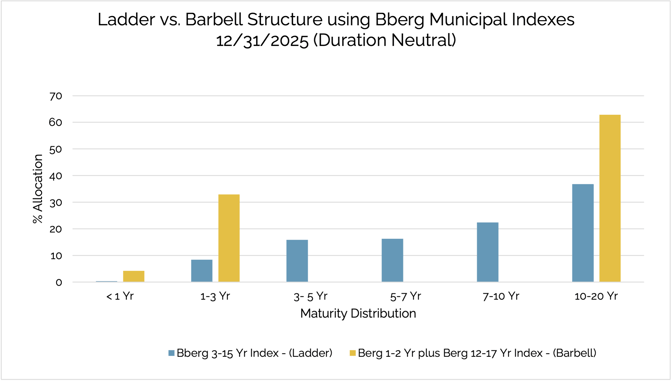
Source: Bloomberg, City Different Investments
The Barbell structure invests at the extremes of the available investment universe; the Ladder invests across the entire available investment universe.
The graph below shows the annual return differences between the two structures (and the total cumulative return differences) for the periods from 1994-2025.
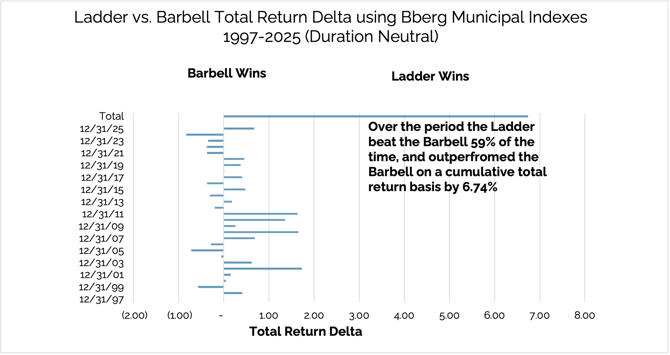
Source: Bloomberg, City Different Investments
The laddered structure does not outperform in every period… but it does outperform 59% of the time (and added 6.74% relative cumulative total return over the period).
The Bullet
The Laddered index vs. the Bullet-constructed index:
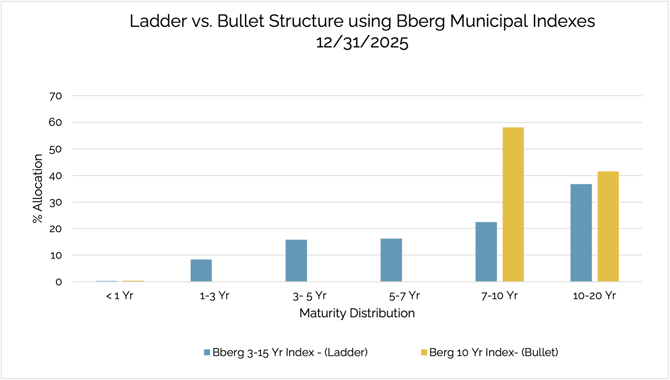
Source: Bloomberg, City Different Investments
The Bullet construction concentrates its investments around specific maturities, while the Laddered structure is more evenly distributed along the available investment universe e.g. “don’t put all your eggs in one basket”.
The graph below shows the annual return differences between the two structures (and the total cumulative total return differences for the periods) from 1994-2024.
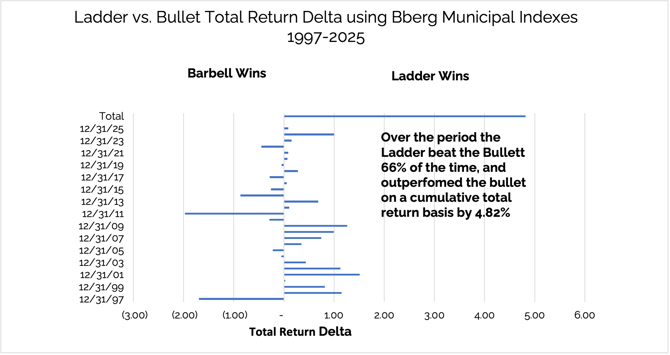
Source: Bloomberg, City Different Investments
We’ll leave you with one thought: The performance data we cited above can be thought of as a “success ratio”. If you were a baseball player and batted between .590 and .660, you’d be the greatest hitter to have ever played the game by a wide margin... that’s double the batting averages of some Hall of Fame players:
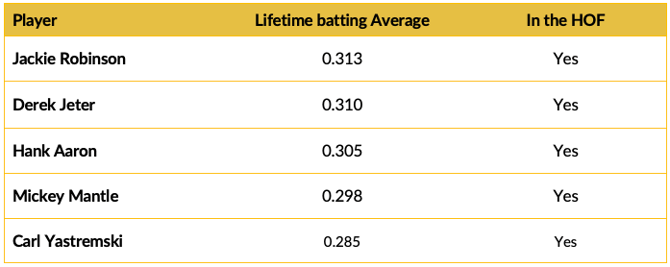
Given the Ladder’s success rate… feels like a Hall of Fame shoe-in to us.
IMPORTANT DISCLOSURES
The information contained in this communication has been designed for general informational, illustrative, and educational purposes only and does not constitute an offer to sell or a solicitation of an offer to buy any security. Moreover, the information provided is not intended to provide any investment advice whatsoever. Different types of investments involve varying degrees of risk, and there can be no assurance that the future performance of any specific investment, investment strategy, or product, or any non-investment related content, made reference to directly or indirectly in this communication will be profitable, equal any corresponding indicated historical performance level(s), be suitable for your portfolio or individual situation or prove successful. Due to various factors, including changing market conditions and/or applicable laws, the content may no longer be reflective of current opinions or positions. No discussion or information contained herein serves as the provision of, or as a substitute for, personalized investment advice. To the extent that a reader has any questions regarding the applicability above to his/her individual situation of any specific issue discussed, he/she is encouraged to consult with the professional advisor of his/her choosing. City Different Investments is neither a law firm nor a certified public accounting firm and no portion of this content should be construed as legal, tax, or accounting advice.
The presented information and statistics have been obtained from sources we believe to be reliable but cannot be guaranteed. Any projections, market outlooks or forecasts discussed herein are forward-looking statements and are based upon certain assumptions. Other events that were not taken into account may occur and may significantly affect the returns or performance of these investments. Any projections, outlooks or assumptions should not be construed to be indicative of the actual events which will occur. These projections, market outlooks or estimates are subject to change without notice. Please keep in mind that past performance may not be indicative of future results.